
Last updated: November 13, 2026
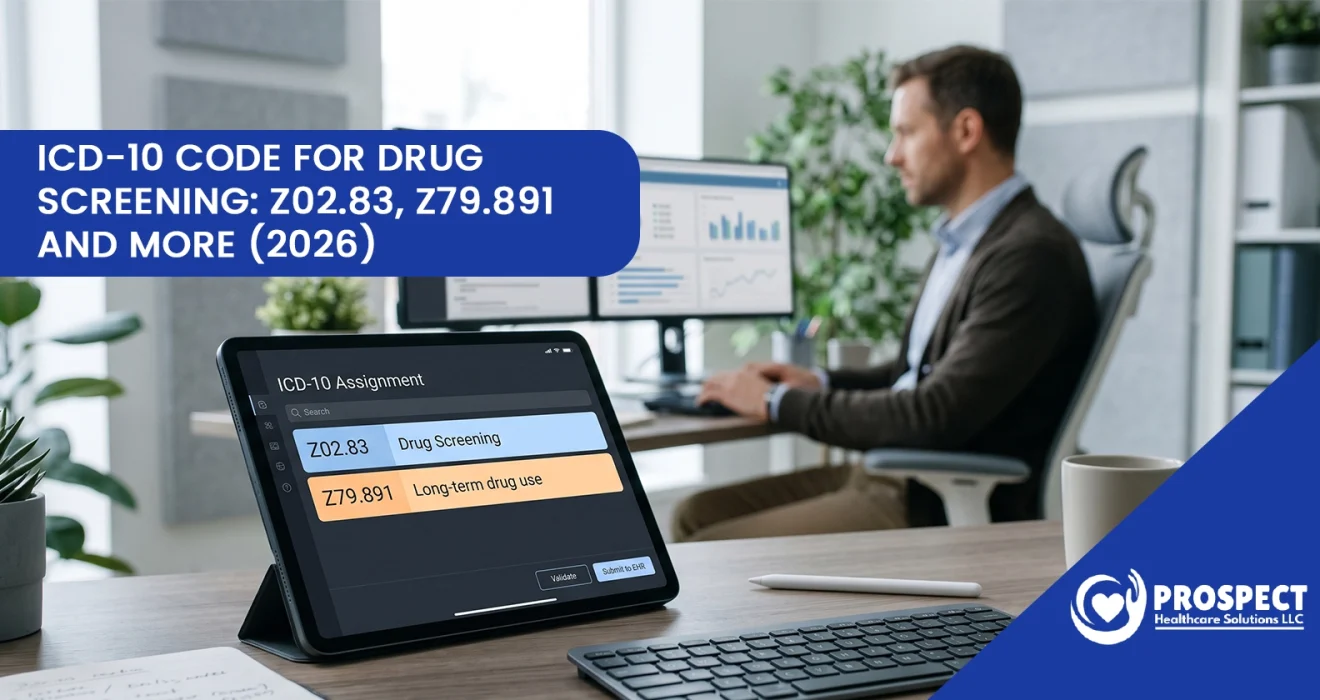
Quick answer: There is no single ICD-10 code for drug screening; the code depends on why the test was ordered. Common choices are Z02.83 for employment or legal testing and Z79.891 for monitoring long-term opioid therapy. Picking the right reason decides coverage, which our medical billing services team checks on every lab claim.
ICD-10 Code for Drug Screening by Reason
| Reason for the test | ICD-10 code(s) | Notes |
|---|---|---|
| Employment, court-ordered or other non-medical drug test | Z02.83 Encounter for blood-alcohol and blood-drug test | First-listed code only. Insurance, including Medicare, generally doesn’t cover non-medical testing; bill the employer or patient |
| Monitoring a patient on long-term opioid therapy | Z79.891 Long-term (current) use of opiate analgesic, with Z51.81 Encounter for therapeutic drug level monitoring | The most common code pair for pain management practices |
| Monitoring other long-term drug therapy | Z79.899 Other long-term (current) drug therapy, with Z51.81 | For example, benzodiazepines or stimulants prescribed long-term |
| Substance use disorder treatment | F-codes for the disorder, such as F11.20 (opioid dependence, uncomplicated), F11.21 (opioid dependence, in remission), F12.20 (cannabis dependence) or F14.20 (cocaine dependence) | Code the specific substance and status from the provider’s documentation |
| Counseling and surveillance of a patient with drug abuse | Z71.51 Drug abuse counseling and surveillance of drug abusers | Add the F-code for the substance use disorder |
| Drugs found in a test result | R78.0–R78.6 Findings of drugs and alcohol in blood (for example, R78.1 opiate, R78.2 cocaine); R82.5 Elevated urine level of drugs, medicaments and biological substances | Use when a result is reported and no diagnosis explains it |
| Suspected poisoning or overdose | T-codes for the poisoning (for example, T40.- for opioids and other narcotics), plus symptom codes | Follow ICD-10-CM poisoning guidelines |
Which Code Comes First?
- Non-medical testing: Z02.83 is first-listed only. If the result is positive, add the R78 code for the finding.
- Medication monitoring: list the long-term drug therapy code (Z79.891 or Z79.899) with Z51.81, plus the condition being treated, such as chronic pain.
- Substance use disorder: the F-code describes the condition; Z71.51 can be added when the visit includes counseling and surveillance.
Medicare Rules for Drug Testing
Medicare contractors cover drug testing through local coverage determinations, titled “Controlled Substance Monitoring and Drugs of Abuse Testing” in several jurisdictions. In general:- Testing has to be ordered for the individual patient, based on their history and risk. Blanket orders for every patient aren’t considered medically necessary.
- Presumptive (screening) tests usually come first. Definitive tests should be limited to the drugs the provider needs to confirm or identify.
- Coverage and frequency limits depend on the patient’s risk level, so the record should show why each test was needed.
- Employment, court-ordered, and other non-medical testing isn’t covered.
Request your free medical billing audit
See where your practice is losing revenue. Our experts review your claims, denials and A/R at no cost.
Drug Testing CPT and HCPCS Codes
The diagnosis has to match the test billed:- 80305–80307: presumptive drug tests, by method.
- G0480–G0483: definitive drug tests for Medicare, by the number of drug classes tested.
- 80320–80377: definitive drug tests by drug, used by many commercial payers.
For practices monitoring patients on long-term opioids, our pain management billing services track drug testing frequency limits by payer.
Positive Urine Drug Screen ICD 10 Code
A positive urine drug screen is commonly reported with R82.5, elevated urine levels of drugs, medicaments and biological substances. It describes the abnormal finding, not a diagnosis.
If the provider documents a related condition, such as substance use or poisoning, code that condition as documented instead of relying on the lab finding alone. Use Z02.83 only for the screening encounter itself, when the reason for the visit is a blood-alcohol or blood-drug test.