

Last updated: November 16, 2026
Quick answer: For an unspecified headache, use R51.9. Use more specific codes when documented, such as G44.209 for tension-type headache or G43.909 for migraine, unspecified. Specific codes reduce denials. Our coders check specificity as part of our medical billing services.
Primary ICD-10 Code for Headache
The general ICD-10 code for headache is R51.9. It stands for “Headache, unspecified.” This code is often used when the exact cause of the headache is unknown.Need help billing neurology claims? Our neurology billing services team handles coding, claim submission and denial follow-up. Request a free coding and billing audit for your practice.
Common Codes for Headache Types
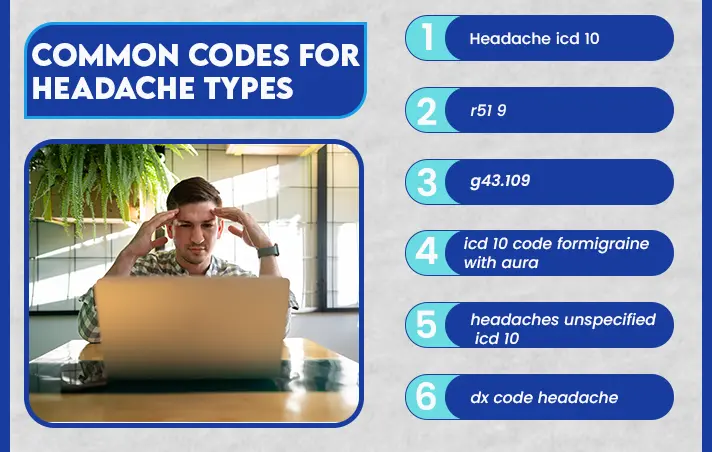
The right code depends on the type of headache the provider documents. These are the codes used most often:
| Headache type | ICD-10-CM code | Code description |
| Headache, cause not documented | R51.9 | Headache, unspecified |
| Headache that changes with position | R51.0 | Headache with orthostatic component, not elsewhere classified |
| Tension-type headache | G44.209 | Tension-type headache, unspecified, not intractable |
| Migraine without aura | G43.009 | Migraine without aura, not intractable, without status migrainosus |
| Migraine with aura | G43.109 | Migraine with aura, not intractable, without status migrainosus |
| Migraine, type not documented | G43.909 | Migraine, unspecified, not intractable, without status migrainosus |
| Chronic migraine without aura | G43.709 | Chronic migraine without aura, not intractable, without status migrainosus |
| Chronic migraine with aura | G43.E09 | Chronic migraine with aura, not intractable, without status migrainosus |
| Cluster headache | G44.009 | Cluster headache syndrome, unspecified, not intractable |
| Post-traumatic headache | G44.309 | Post-traumatic headache, unspecified, not intractable |
| Medication overuse (drug-induced) headache | G44.40 | Drug-induced headache, not elsewhere classified, not intractable |
How the migraine codes work: the fourth character sets the type (G43.0 without aura, G43.1 with aura, G43.7 chronic without aura, G43.E chronic with aura, G43.9 unspecified). The fifth character says whether the migraine is intractable (1) or not (0), and the sixth whether status migrainosus is present (1) or not (9). So an intractable migraine without aura and without status migrainosus is G43.019, not a separate “intractable headache” code.
G43.109: Migraine With Aura, Not Intractable
G43.109 is migraine with aura, not intractable, without status migrainosus. It is the right code when the provider documents migraine with aura (for example, visual changes before the headache) that responds to treatment and has not lasted more than 72 hours.
| Code | Migraine with aura that is… |
|---|---|
| G43.109 | Not intractable, without status migrainosus |
| G43.101 | Not intractable, with status migrainosus |
| G43.119 | Intractable, without status migrainosus |
| G43.111 | Intractable, with status migrainosus |
| G43.E09 | Chronic migraine with aura, not intractable, without status migrainosus |
Use G43.909 only when the type of migraine is not documented.
R51 is no longer billable. On October 1, 2020, R51 was replaced by R51.0 and R51.9. A claim that still uses R51 on its own will be rejected.
Codes are from the ICD-10-CM code set published by CMS. Always check the current year’s code set before billing.
Tips for Correct Coding
- Always assess the type of headache before choosing a code.
- Use a specific headache code only when the provider documents the headache type.
- Don’t code frequency alone; code the headache type that is documented.
- Be cautious with vague descriptions such as “head pain”; ask the provider to document the type.
Why Correct Coding Matters
Using the correct ICD-10 code can:- Reduces the insurance claim denials.
- Help in fast processing of insurance claims.
- Give proper medical documentation for follow-ups.
- Avoid confusion and helps doctor to understand the patient’s condition
Request your free medical billing audit
See where your practice is losing revenue. Our experts review your claims, denials and A/R at no cost.
Common Mistakes in Headache Coding
- Using unspecified codes like R51.9 too often.
- Confusing migraine with tension headache.
- Ignoring modifiers like “with aura” or “intractable.”
- Choosing a code without enough clinical detail.
- Missing secondary symptoms that could change the code.
Tips to Choose the Right Code?
- Ask the right questions
- Use the patient’s history to check for aura or frequency.
- Refer to the headache code table above.

